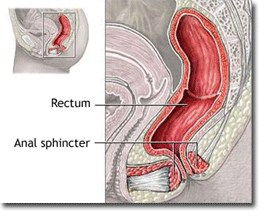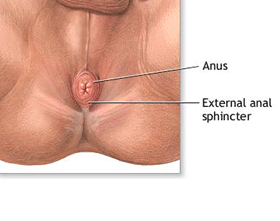
| Two sets of muscles separate the colon from the outside world. One is the internal anal sphincter muscle. The other is the external anal sphincter muscle. Known as the anus. As feces collects in the rectum it puts pressure on the internal anal sphincter muscle, where nerve endings send a message to the brain signaling its time to move your bowels. Ignoring the signal will generally end up causing constipation. Constipation can be from mild to severe depending upon how long you ignore the signal to have a bowel movement. | ||
|
||
| Remember that the anus has literally thousands upon
thousands of nerve endings, and if you injure it, it is likely to be very
painful. So great care must be taken whenever inserting anything into the
anus. Anything with a sharp edge can scratch or cut the delicate anal tissue.
Dealing with an anal fissure can be a long and very painful
experience. You need to inspect, anything that you're going to insert into the anus
for sharp or ragged edges to avoid injury. The people that are most susceptible to anal injury are people with hemorrhoids. Hemorrhoid tissue is thinner and more susceptible to injury. |
||
| Many of us as we get older tend to have less muscle control than when we were younger. This holds true for the anus (anal sphincter muscle). Especially when have intestinal problems like diarrhea or taking an enema, trying to hold the nozzle and or the enema solution in. However, there are some products that can help us with this. One is the retention nozzle or a balloon catheter and the other is a retention plug. |
You can Use your back button to return to the previous page.


For
qualaity enema and colonic supplies + much much more
visit Enema Supply.Com

Bulk herbs
as well as an amazing supply of medicinal herbs and aromatherapy

Complete your
body regimen with yoga for the mind and body + an assortment of great products.

Coffee enemas have amazing benefits for
detoxifying the liver. Try Wilson's special brew!

Visit Herbspro.com for
Branded Vitamins and Herbal Supplements

Warning: Do not use enemas or laxatives if abdominal pain, nausea, or
vomiting are present unless directed by your health care provider.
Rectal bleeding or failure to have a bowel movement after use of a laxative or
enema may indicate a serious condition.
Discontinue use and consult your health care provider.
Statements contained within these web pages are for informational purposes
only,
and have not been evaluated by the FDA.
These products and information are not intended to diagnose, treat, cure, or
prevent any disease.
If pregnant or have an existing medical condition consult your healthcare
provider before using.